asking myself this as I read about a man named Lish.
Gordon Lish.
Editor of Raymond Carver. Friend of Don Delillio.
I learned about him as a quick aside mentioned here in this YT video on White Noise which sent me googling and found me here at this ’expose’ in the nytimes in 1998 about how Lish edited Carver’s early works quite a lot, it seemed, and perhaps enough to say that he was the guy who wrote them?
The entire thing hinges on ideas about authorship and ego and the eternal question of our eternal now: to whom may I credit this genius?
We are obsessed with it and so am I.
I’m only a few paragraphs into the Lish piece. I’ll return here hopefully with more once I finish, if I do.
More so, though, I want to learn more about Lish as an editor. I want to learn about editors more generally. Being one myself, of my work and others’, I haven’t ever really realized that it’s a job. No, I knew that, but I never realized that it might be a thing for which there is style and thought and even schools of thought.
Lish was apparently quite a big deal, according to this piece in the Guardian:
Also look at how dirty they did him with this photo:
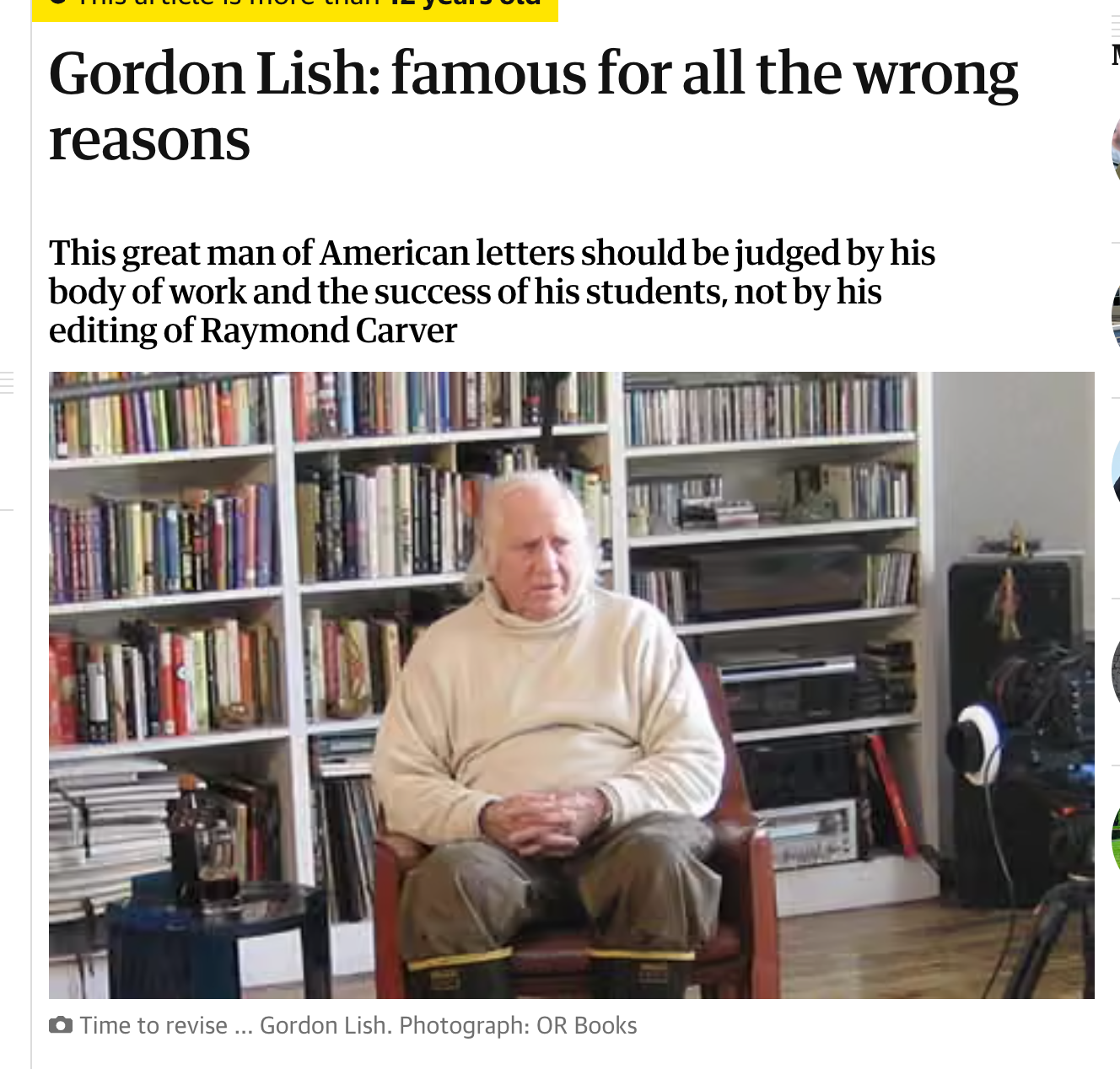
Are those fisherman boots?
Perhaps they did not do him dirty. Perhaps it is I doing him dirty now by needing the photo to be sexy and smart and worthy of the heft of the man it portrays. As if the photo is what matters.
According to delillo, Lish is famous for all the wrong reasons. I’d take famous for any reason, I think, and so would most of my brethren. Perhaps this is our modern malaise - we do not care for what we are known, but simply that we are?
Most of all, I’m interested in Lish as a teacher of writing, another role I know exists but refuse to believe in like Santa in reverse. Perhaps I refuse rather to believe that such teaching could possibly help, for what is will always be etc.
Nonsense.
I mean, listen to this:
Sometimes described as “cult-like”, Lish’s classes became incredibly controversial. There are stories of one student fainting during these arduous all-night affairs; in 1992, he sued Harper’s for reprinting his teaching material.
Now I need to know what he taught. Luckily, it’s here in the Paris Review - https://archive.is/ateQA.
Some thoughts on what makes a great editor based on this interview include…
You gotta love people’s writing
I could spend forever telling you tales about Kesey and Cassady. At the time I fell all over myself in devotion to Kesey’s writing. Yeah, I loved Kesey and his work. I loved the shit out of him, an utterly alive fellow, as was Cassady. But Cassady was gentle and dear and sensitive and kind. Kesey was anything but. He could be a pretty trying fellow and we became increasingly less palsy. There were all the kids he collected around his place in La Honda, that claque, and by the time Tom Wolfe turned up on the scene, I was plenty absent from it.
You gotta notice who might be a great writer and back em
INTERVIEWER How did you first start editing Raymond Carver?
LISH I was under contract to revise The Perrin-Smith Handbook of Current English for Scott, Foresman. My editor, Curt Johnson, came out to Palo Alto to see his people on Scott, Foresman contracts, and also his contributors to his lit mag December . I was both. Carver had been a contributor and, I guess, a good buddy of his. I was at Educational Development Corporation at the time, working on A Man’s Work
So we were supposed to meet, and Johnson phoned to say, I can’t keep my appointment with you, I’m stuck here on California Street with a guy who’s too drunk to get home and his car won’t start. I rode my bicycle over there. That was how I met Carver. Then it was revealed that Carver worked across the street from my office. He was a textbook editor at Science Research Associates. When I got the idea to start up a new lit mag, I thought, Well, here’s somebody who will give himself to the endeavor. On one or two occasions, he came to my apartment and I fed him lunch and we talked about starting something called The American Journal of Fiction. There’s a photograph of Carver sitting at Barbara’s and my dining table, sky-high candlesticks on it, with Ray wearing a shirt of mine. Took the picture for some book he was bringing out.
You gotta notice the little details
The ‘69 World Series was playing on his radio, and he had his feet up on the desk and he seemed to me quite as glamorous as he had seemed to me from a distance and what is most memorable about the meeting was his nonchalance. He was smoking—I believe he was pretty much a chain-smoker of Camels. And he was throwing the matches into a wastebasket and had set it afire. I noticed this and with some alarm, but noticed with equal alarm that he did not seem much interested in what was beginning to be a true blaze. And I tried to catch his attention on that score and he, without even rising from his position lazing back in his chair with his feet above the desk, picked up a New York telephone book and threw it into the wastebasket and extinguished the fire.
sources: https://www.theguardian.com/books/booksblog/2013/aug/29/gordon-lish-80-raymond-carver